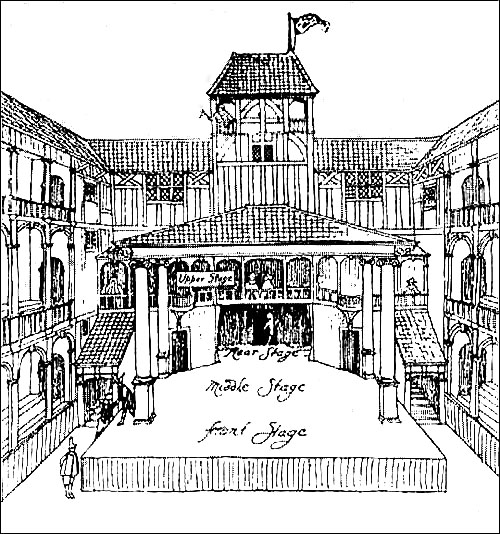
Imagined interior of London’s Fortune Theatre (1599). Sketch ©Oregon Shakespeare Festival, Ashland.
Occasionally a colleague responds to the term Theatrical Intelligence with “Isn’t that an oxymoron?” and much as it irks me to hear it, I understand. Theatrical logic doesn’t make much sense to those who are not in the theatre.
The theatre ditty below reflects amusing contradictions in what some think of as our oxymoronic world
In is down, down is front Out is up, up is backOff is out, on is in
And of course Right is left and left is right. A drop shouldn’t
And a block and fall does neither. A prop doesn’t
And a cove has no water. Tripping is OK.
A running crew rarely gets anywhere
A purchase line will buy you nothing
A trap will not catch anything And a gridiron has nothing to do with football. A strike is work (in fact, a lot of work) And a green room, thank God, usually isn’t. Now that you’re fully versed In theatrical terms…”Break a Leg”. But not really. Author Unknown The language is confusing but absolutely explainable.
In fact, there is a long history of theatrefolk being thought of as not quite normal or respectable: in the early 20th century, it was common to see NO THEATRICALS signs on reputable hotels and eateries; women onstage were assumed to be prostitutes. Yes, the prejudice was rampant.
When Actors’ Equity was founded in 1913 as the first labor union in the performing arts industry, it paved the way for The Four A’s: the Associated Actors and Artistes of America.
These days there is a national hunger for creativity in the workplace. Corporations, governments, academic organizations and communities of all kinds are looking to artists for inspiration and answers to the lack of satisfaction of their workers. It’s the reason I’ve started leading Theatrical Intelligence Workshops, because it’s time to spread the word.
So,what is the answer to the question “Is Theatrical Intelligence An Oxymoron?”
YES, if you’re a skeptic.
NO, if you’re willing to challenge your assumptions and imagine a stage as the center of your world.
For those of us who work in the theatre, that’s what we’re lucky enough to do every day.
I think ‘Theatrical Intelligence’ is a clear, precise, and actually brilliant description of what I would call an awareness, a sensitivity, a mind set, either innate and developed, or acquired through experience, that comes into play in the performance of a specific, artistic genre . . theatre. Most people who are committed to an activity that absorbs their whole being can usually be said to have a sixth sense in relationship to the performing of it, that bonds them to that activity with a heightened awareness/ intelligence, that would not otherwise come into play. There’s also ‘musical intelligence’, ‘seafaring intelligence’, cinematic intelligence’, and on and on. Jokes about it are silly to me and are part of that tradition you described, of sneering at what is not understood, ie. the arts and artists, and at what is perhaps, unfortunately experienced as elitst.
So well said, Jane. Thank you for seeing the context and the wisdom of so many other intelligences. And thank you Howard Gardner, who got it all started with Multiple Intelligences! http://www.howardgardner.com/FAQ/faq.htm
It is my quest to take the elitism out of it. In fact I love non-arts people in the workshops, because it brings them such joy.
Ann –
Have you read Dan Pink’s “A Whole New Mind”? He argues that the intelligence we need to compete in the future needs to combine the traditional left-brained modes of thinking with more right brain creativity. It isn’t either or, its both.
So TI sounds to me like creativity, showmanship, communication, design, and all the kinds of intelligence that Pink cogently argues we cannot compete today without.
Would love to hear your thoughts.
Yes, Bonnie – you are right on target! I read Dan Pink’s book the day it came out.
Also, my theory of Theatrical Intelligence is influenced by three generations of my family who were neurologists and then neurosurgeons. I’ve been fascinated by the balance of right brain-left brain thinking since the time I was a child, although I didn’t know that’s what it was at the time.
Would love to have a conversation about this.
Hello there. I like that you have shared Theatrical Logic. I see it occasionally on different websites. As far as “Author Unknown”… well, to that I can shed some light.
You see this was authored by myself, right here where I’m sitting right now, in my office at Cypress College in Cypress, California where I have worked since 1985. I wrote it in an attempt to clear things up for new students of Theater and Dance who consistently got confused by our use of theatrical terms. It was, at least orginally, meant to be instructional but turned out to be just a fun way to confuse them even further. I printed it off my old Macintosh XL and posted it on the bulletin board right outside my office where it hung for years and years. Occasionally it would turn up missing and I would print a new copy to post. I suppose someone, somewhere along the line shared this on the internet, and the rest is history. Just goes to show you how something that ends up on the internet really does end up with a life of its own.
One of the terms, a cove, is acually rarely used in theater circles and was somewhat unique to our building. In fact, we don’t really use the term here any longer either but instead use the more common term… box boom. So in that sense, this work is dated.
Anyway, I suppose I will likely never get credit here since I have little way to prove my claim. Maybe I’ll post something on my facebook page where I have almost 30 years of former students who can affirm that I wrote Theatrical Logic. Maybe one of them will confess to sharing this on the internet in the first place.
Have a nice day.
Thank you for your comment, Steve. No doubt you are aware that THEATRICAL LOGIC is widely known and well loved in the professional theatre community. I encourage the idea of using Facebook to rally your students to acknowledge you as its author. It would solve a longtime theatrical mystery! Please keep me posted.
Note: Alas, your comment was lost in my site’s spam folder for entirely too long. I’m glad I caught it, but wish I had seen it sooner!
Actually, the International Alliance of Theatrical Stage Employees and Moving Picture Artists and Allied Crafts of the Untied United States and Canada, commonly known as the IA was formed in the 1880’s first in New York City. My Local, Local#38 in Detroit Michigan was formed in 1894 so we pre date Actors Equity by almost 10 years. On at the Fisher Theater in Detroit, we do call the lighting area nearest the stage in the ceiling, “the Cove.”
Warren Wilson… The lighting position you are describing is not the same as the lighting positions in our theater that use to be called coves. About 25 years ago we stopped referring to them as coves and adopted the much more common term… box booms which are not in the ceiling as you describe but in the walls on either side of an auditorium. You can see I am just recently revisiting this site and will do as Ann Sachs suggests and use our Cypress College Theater and Dance Department Facebook group to rally behind my claim. Not that it really matters a whole lot. I’m thrilled that ‘Theater Logic’ has come to be enjoyed by so many more people than I ever dreamed of. It just caught me off guard when I saw that it was noted as “author unknown”.
By the way Ann, I find your discussions on Theatrical Intelligence to be fascinating. It is a shame that the art form and the benefits of its training are not more widely appreciated. Unless one happens to be a lone mime on a street corner, I view the producing a theatrical production as the ultimate collaborative art requiring an unparalleled level of teamwork and cooperation.
Firstly – Ann – what a terrific blog! I can’t believe I have only just discovered it after working in theatre and education for 17 years. I’m a new fan for sure! Today, I came across a copy of ‘Theatrical Logic’ that was given to me an event at the Royal Opera House in London. I took a photo of the printed postcard and put it on Instagram (@TreePress if you’d like to see it!) saying how much I wished I knew who the author was so I could give them credit. With a bit more searching – I’m so delighted to have found this post! Steve – do you use Instagram or Twitter? If so – it would be great to be able to connect you to the many people who are loving your poem online! Let’s let the world know who you are!! Would love to help spread the word! Adrienne :o)
Welcome, Adrienne, what a pleasure to meet you. Alas, I’ve neglected my beloved blog recently for another project… however, I agree that Steve Banneck deserves acknowledgement as the author of THEATRICAL LOGIC. Have you reached out to Steve at Cypress College? I hope he has rallied his students from 30-years-ago to help him lay claim to it. And I applaud your “spread the word” spirit!