Posts Tagged ‘Actor’

When You’re Feeling Stuck…

Saturday, January 14th, 2012

An earlier version of this post was published as “What Role Were You Born to Play?” in June 2009.

When you’re feeling creatively stuck, it’s time to rediscover your Theatrical Intelligence. Identify those inborn talents of your youth – the ones that went into hiding as you morphed into an adult – and presto change-o - you’ll get unstuck!

Behind the stage door, great wisdom lives…

Try this:

Think back to your childhood. Remember the neighborhood where you grew up?  Close your eyes, take a deep breath, and inhale the smell of that long ago place. If the neighborhood isn’t quite clear for some reason, or if you moved around a lot, breathe in a moment or two when you shared secrets with your closest friend…

As you’re breathing, ask yourself: Was there a time when you and your friends decided to put together an event of some kind?  A gymnastics demonstration? A neighborhood circus with performances by your pets? Maybe a swimming show with a lemonade stand? Whatever it was, YOUR part in this event made you really proud.

Write down what you remember. I’m willing to bet that your actions resemble those in one or more of The 8 Roles of Theatrical Intelligence, listed below:

1.    The WRITER: You had an idea and wrote it down. You understood the concept: tell the audience, tell them again, and tell them that you told them; with humor, drama and clarity.

2.    The ACTOR: You performed. You lived moment-to-moment. You understood that timing is everything, and that theatre isn’t larger than life – it is AS LARGE as life!

3.    The DIRECTOR: You “saw” the ideas as if they already existed, then staged it to please the audience. Your friends placed their trust in you because you gave them positive feedback about their strengths, and you made them feel good about themselves.

4.    The PRODUCER: You thought up the whole event, assigned your buddies the tasks that matched their strengths, sold the idea to everyone in the neighborhood and got them to pay for tickets. You invited everyone you saw, and one restaurant owner was so enthusiastic he threw an after-show party at your request.

5.   The DESIGNER: You envisioned the environment for the event. You drew it with vivid strokes and it took on a life of its own. You told your friends what to build, what to wear and why they had to wear it in spite of their objections (and they thanked you for it afterwards!)

6.    The STAGE MANAGER: You knew that your best buddy’s vision could be built. You crafted the schedule as to what had to be done by when, so your friends would have a chance to practice. You arranged parking places for bikes, strollers, cars, and managed the traffic and access to rest rooms.

7.   The TECHNICIAN: You made calculations from your friend’s drawings, found the right person to donate materials and stayed up all night building the set. You finished on time, and with no budget. When people got nervous and asked “What’s happening?” you replied “Workin’ on it!”

8.    The CRITIC: You recognized problems from the get-go, and knew that if the project had been approached from a different perspective it would have worked better. But heck, it was fun, and set the precedent for the next time. You wrote a flattering article for the Neighborhood News, in which you had instigated the “Kids’ Column”.

Do any of these roles sound familiar?

I believe that every one of us was born with Theatrical Intelligence. As kids, chances are that we played at least two roles with complete abandon. And as we morphed into grown-ups, many of us ended up playing a role that didn’t quite fit.

  • What was the role (or roles) that you played?
  • Are you currently playing one of them in your daily life?
  • If not, when did it (they) go underground?
  • What was it about the event that made it so unforgettable?
  • Can you imagine experiencing it again?

The goal of Theatrical Intelligence is to IDENTIFY the roles that gave you such joy and freedom as a child, TAP INTO that creative pulse you’ve been craving, and USE IT in your daily life.

Once you’ve experienced that pulse it will keep on beating – hold it close to you. Unexpected opportunities await.

On Writing and Handwriting

Thursday, April 28th, 2011

I’ve always had beautiful handwriting. With minimal effort on my part, penmanship was the only subject for which I consistently received an A+. Learning the Rhinehart Handwriting Method in third grade felt to me like initiation into adulthood: I was writing cursive clearly, I was grown up.

Since that time, I’ve hand-written countless invitations at the request of friends, “penned the place cards” for many events, and if there is ever a call for a designated scribe, I’m it. Clear, legible handwriting was just something I did; I never even thought about it.

During a recent Theatrical Intelligence Workshop a distant memory crept into my mind about winning a United Nations Essay Competition for high school students in New Hampshire. I had forgotten about this honor for 45 years and as I was pondering the reason why, it suddenly struck me: I was convinced that I’d won because of my handwriting. Every one of the judges commented about my beautiful writing*, yet it never occurred to me that they were referring to content, or style, or ideas in my essay. Of course I forgot the award – the reason (I thought) I had won it had no meaning to me.

If you had known me in high school you would have known I was obsessed with the theatre. Jeezum crow (as we used to say in New Hampshire) everyone in in my whole town knew I was going to be an actress – I had a reputation to uphold! At no time in my first seventeen years did it even cross my mind that I might do anything else. I discovered my passion early, and pursued it with a vengeance.

For twenty-five years that’s what I did; until I didn’t want to any more.

Readers of this blog are familiar with my belief that we all come into the world with Theatrical Intelligence and it often goes underground as we morph into grownups. Imagine my delight when my own theory provided insight into one of my own roles.

That role is writer. And the task is writing. Not handwriting.

*Truth be told, one out of the five judges did use the phrase “old fashioned penmanship”. That’s the only one I remembered, of course.

A Leap of Faith: Actor. Warrior. Hero.

Monday, October 26th, 2009

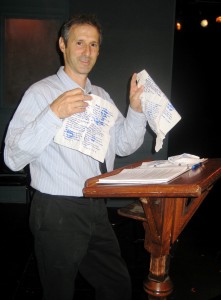
Rich Topol: Actor. Warrior. Hero

Rich Topol: Actor. Warrior. Hero

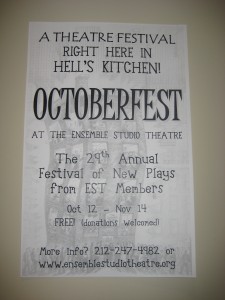
I just completed directing a project in the 29th Annual Octoberfest at the Ensemble Studio Theatre* in New York’s Hell’s Kitchen. I am writing this blogpost because an exceptional actor named Richard Topol has inspired me. Rich, as everyone calls him, is a perfect example that actors are as courageous as any warrior. Truly, they are heroes.

Rich probably has no idea how much his work meant to me in the few days we worked together.  I suspect he believes he was just doing what he does as an actor.

The project was David Perry’s Eulogy, a one-person play in which a man comes to an emotional reckoning with his abusive mother as he eulogizes her. The play could be described as the technical equivalent of singing four arias in forty minutes and performing Hamlet’s soliloquies in between. And this with one rehearsal.

I had seen Rich on Broadway in a hilarious and heart wrenching performance in Awake and Sing, but met him for the first time at our one rehearsal prior to the two readings. Within 5 minutes it was clear that he trusts himself to exist fully in the moment; if he gets lost along the way he has the courage to live in the unknown – essentially in free-fall – until he discovers something he can grab on to and move on. This, of course is one of the principles of Theatrical Intelligence: success comes with having the courage to step into the unknown.

Actors must find a comfort level with whatever they’re doing, and a staged reading of a demanding script in front of a savvy audience with virtually no rehearsal can be daunting. Many actors just won’t do it. Understandable. It is rather like being asked to jump off a cliff not knowing if your parachute is going to open. Other actors, and Rich is one, are willing to take that leap of faith, and jump.

In the talkback after the first of the two readings, when asked about his experience during the “performance”, Rich responded  “It was exhausting! Sometimes I didn’t remember what was coming next on the page, and when I got there it wasn’t what I expected. So I thought, OK, I’ll live here for a while and just see what happens.”

86 Plays. 38 Days.

86 Plays. 38 Days

What if we could all live this way every day? “Live here for a while…” not knowing where it might lead. If we can trust that it is OK not to know where we are emotionally or intellectually or spiritually, it leaves open the possibility of discovery. If we are open to discovery, just think what new things we can learn!

Billy Carden, the Artistic Director of EST, says: “…if you believe in discovery, if you want to be entertained by the unexpected, surprised by the spontaneous, if you want to hear a new voice for the first time, or a familiar voice in a new way, if you want to experience the spirit of work in progress: join us.”

Thank you, Rich, for your leap of faith. You are a hero.


*EST was founded in 1972 to nurture individual theatre artists in the development of new American plays, and has produced 6,000+ new works over the decades.  I have been a lucky member of this family of 500 theatre artists since 1977.

What Role Were You Born To Play?

Sunday, June 21st, 2009

Recently I’ve re-connected with some old friends who cannot wait to retire. They’re ready to do what they’ve “always loved doing” because for one reason or another, they didn’t end up doing it in their regular work.

Behind the stage door, great wisdom lives...

If you are stuck in a job you don’t like, tapping into your Theatrical Intelligence can help. Identifying your inborn talent(s) that may have gone underground in your adult life, can get you unstuck.

Try this:

Think back to your childhood. Remember the neighborhood where you grew up?  Close your eyes, take a deep breath, and inhale the smell of that long ago place. If the neighborhood isn’t clear, or you moved around a lot, picture a time when you shared secrets with your closest friend…

Was there a time when you and your friends decided to put together an event of some kind?  A gymnastics demonstration? A neighborhood circus with performances by your pets? Maybe a swimming show with a lemonade stand? Whatever it was, YOUR part in this event made you really proud.

Write down what you remember. I’m willing to bet it resembles one or more of The 8 Roles of Theatrical Intelligence:

1.    The WRITER: You had an idea and wrote it down. You understood the concept: tell the audience, tell them again, and tell them that you told them; with humor, drama and clarity.

2.    The ACTOR: You performed. You lived moment-to-moment. You understood that timing is everything, and that theatre isn’t larger than life – it is AS LARGE as life!

3.    The DIRECTOR: You “saw” the ideas as if they already existed, then staged it to please the audience. Your friends placed their trust in you because you gave them positive feedback about their strengths, and you made them feel good about themselves.

4.    The PRODUCER: You thought up the whole event, assigned your buddies the tasks that matched their strengths, sold the idea to everyone in the neighborhood and got them to pay for tickets. You invited everyone you saw, and one restaurant owner was so enthusiastic he threw an after-show party at your request.

5.   The DESIGNER: You envisioned the environment for the event. You drew it with vivid strokes and it took on a life of its own. You told your friends what to build, what to wear and why they had to wear it in spite of their objections (and they thanked you for it afterwards!)

6.    The STAGE MANAGER: You knew that your best buddy’s vision could be built. You crafted the schedule as to what had to be done by when, so your friends would have a chance to practice. You arranged parking places for bikes, strollers, cars, and managed the traffic and access to rest rooms.

7.   The TECHNICIAN: You made calculations from your friend’s drawings, found the right person to donate materials and stayed up all night building the set.  You finished on time, and with no budget. When people got nervous and asked “What’s happening?” you replied “Workin’ on it!”

8.    The CRITIC: You recognized problems from the get-go, and knew that if it had been approached from a different perspective it would have worked better. But heck, it was fun, and set the precedent for the next time. You wrote a flattering article for the Neighborhood News, in which you had instigated the “Kids’ Column”.

Do any of these roles sound familiar? Even at an early age your Theatrical Intelligence was at work.

What made your event so unforgettable? What worked?

You wanted everyone to talk about the event all week! That is the first of The 6 Principles of Theatrical Intelligence:

1. Everyone shares the same goal.

Next, everyone would’ve been mortified if no one showed up, if one of the pets didn’t cooperate, or if the setting wasn’t finished. Embarrassment doesn’t begin to describe it! That’s the second principle:

2. Everyone shares the risk.

What else worked? Everyone worked together and beat the deadline!  Third principle:

3. Collaboration rules!

The 4th principle takes over (sometimes against all odds) when a show is being developed:

4. The work matters.

Chances are that you experienced 4 of The 6 Principles before you were 8 years old.

(The 5th and 6th principles occur when there’s a more sophisticated level of production: 5. Failure is your friend, and the fastest way to learn. 6. Success comes with the courage to step into the unknown. We’ll take those on later.)

I believe that every one of you was born with Theatrical Intelligence. As a kid, chances are that you played at least two roles with complete abandon. And as you morphed into a grown-up, you may have ended up playing a role that didn’t quite fit. It happens to many of us.

What was the role you were born to play?

Are you currently playing it?

If not, when did it go underground?

How will you get it back?

The goal of Theatrical Intelligence is to IDENTIFY the role(s) that gave you such joy and freedom as a child, and put them to USE in your daily life.