Archive for the ‘Theatrical Intelligence’ Category

Theatrical Lingo

Theatrical lingo, much like theatrical logic, works sort of like a secret code. “BREAK A LEG” in theatre jargon, for instance, means “Good Luck!” The term refers to the “break or bend of the leg” while taking a bow or curtsy. It’s as if the felicitation says “Great success tonight, with many curtain calls!”

A few favorite examples of this imaginative (sometimes loony) lingo are listed below:
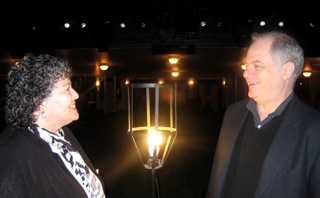
Frank Rich and I share a laugh...

GHOST LIGHT: Theatrical superstition says that if an empty theatre is left completely dark, a ghost will take up residence. That’s the reason a single ghost light is left burning center stage in every theatre in America, after everyone has gone home. I’ve often wondered if the light is to keep the ghosts out, or to welcome them in. Probably both.

The light also serves as a practical safety measure in case someone wanders near the edge of the stage without knowing that an orchestra pit looms below, awaiting their potentially hazardous fall.

The fact that I cherish most about ghost lights, however, is that each one is carefully crafted by a stagehand. And like snowflakes, no two are alike. 

Frank Rich’s memoir, Ghost Light, is required reading for anyone serious about the theatre. (Is it necessary to disclose that Mr. Rich modeled the definitions of Writer and Critic for me decades ago? Well, anyway, he did. And he continues to inspire me with his Theatrical Intelligence in our changing world.)  He and I had a good laugh recently on the stage of Broadway’s Nederlander Theatre (see photo above): the usual clear filament bulb had been exchanged for a CFL – a compact fluorescent, or “green” bulb!  Less traditional perhaps, but a good superstition is hard to kill.

GEORGE SPELVIN: A fictitious theatrical name. Actors use this pseudonym to remain anonymous or to avoid their name appearing twice in the program if they’re playing more than one role. Sometimes the name is used when a character mentioned in the text never appears onstage; by crediting the role to “George (or Giorgio, Georgina, Georgette) Spelvin”, the audience isn’t tipped off that the character never shows up. Occasionally Actors Equity members working under a Non-Union contract (alas!) use the name to avoid penalties associated with Non-Union work.

VOMITORY: In a thrust or arena theatre, a vomitory is a ramped or stepped tunnel, giving performers access to the stage from beneath the seating area (see photo, right, of Arena Stage in Washington, DC). The term probably originated from the days of Roman amphitheatres, when those who were thrown to the lions managed to escape to tunnels under the arena, vomiting along the way. (Gross enough for you?)
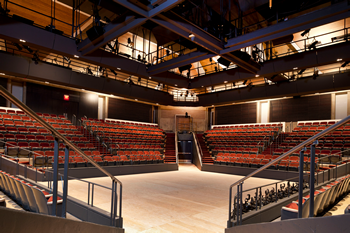
Arena Stage's Fichandler © Nic Lehoux

Theatrical lingo includes hundreds of colorful terms, and just as many off-color ones. Please share your favorite in the Comment section above.

If you’re the first to come up with one I’ve never heard of, you’ll be my guest at a Broadway show!


 

Words Frozen Until Spring? (It’s All In The Timing)

I am in bed with pneumonia, taking an unplanned vacation from my life during a New York City blizzard.

With impeccable timing, a friend posted a quote on Facebook from Plutarch, which appealed to my pneumonia-induced-thinking:

Frozen“Antisthenes says that in a certain faraway land the cold is so intense that words freeze as soon as they are uttered, and after some time [they] thaw and become audible, so that words spoken in winter go unheard until the next summer.”

These ancient words make me think that pneumonia might not be so bad. As long as I don’t die from it. (Thank you, O science-world, for antibiotics!)

Yes, the pneumonia has jiggled my system; it has rendered reality ridiculous; it has produced middle-of-the-night-hallucinatory-conversations with long forgotten relationships. Weird. Scary. Kinda like drugs in the 60’s. (Though I was never a druggie, my friends always got a kick out of the fact that my vicarious high made me seem more stoned than anyone in the room.)

Which brings me back to the frozen words. I am staring at the 2011 calendar, on which “one month plus” of bed rest has been prescribed by my doctor. In pneumonia-zone, time is slower than the clock by far. So it is comforting that my thoughts and words might freeze for a while – it seems perfect, in fact – that they are frozen as we are snowbound in the city.

Come spring, when I am ready to venture back into the world, my words will have melted. And I will be ready to hear them.


Theatrical Intelligence Workshop: NYC

There is more to what you do than meets the eye.

And it cannot be seen through a regular lens...

Learn to look through another lens: use Theatrical Intelligence.

What is Theatrical Intelligence? It’s a process that uses theatre concepts to impact work performance. In this workshop you’ll identify the role(s) you were born to play by tapping into one or more of its 8 roles as your own creative strength.

Join us in a supportive, collaborative environment, and discover “the fun part of being smart!”


The ACADEMi of LIFE

presents

A Theatrical Intelligence Workshop

THE MUSE HOTEL

130 West 46th (6th & 7th)

$195. (lunch included)

REGISTER HERE (Click CLASSES)


WORKSHOP LEADER:

ANN SACHS: President and CEO of Sachs Morgan Studio, former leading actress on Broadway; award winning entrepreneur and founder of Theatrical Intelligence.

“There is no joy in living without joy in work.” Thomas Aquinas


A Foreword For My Book… Or A Backward?

(A Loony Moment of Escape)

An eminent person is sometimes said to be helpful...

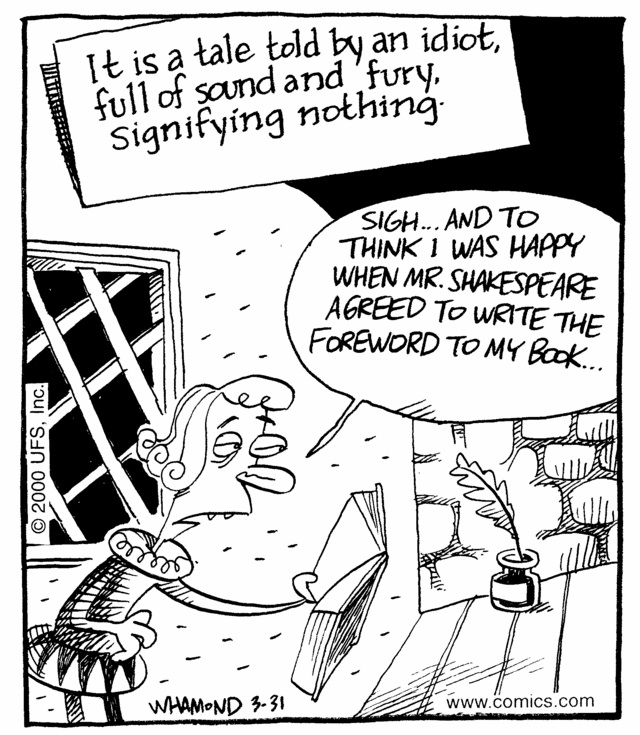
For weeks I’ve been obsessed with whom I might ask to write the Foreword to my book. Tonight, my husband offered to write a “Backward”.

Granted, this was probably a gesture intended to shut me up. My husband, however, is a guy with wild ideas that often work, so I listened. A “Backward” would be the opposite of a Foreword, he explained; instead of laying out why the book matters, it would summarize what people will remember. He went on to persuade me that “Backwards” will be a forward trend in publishing.

I ignored the fact that his idea reminded me of Father Guido Sarducci’s Five Minute University because I was convinced. We all know that people don’t read any more – I mean books are written about the fact that nobody reads them!  Who cares that I have spent this year consumed with writing, re-writing, cutting, purging, drilling down, down, down into this concept I am passionately committed to? Chances are that nobody will read the damned book anyway! A “Backward” sounds reassuring to me – a momentary escape from the thought that maybe no one cares.

So I’ll finish writing the book. I’ll find an eminent person to write the Foreword. And Roger will explain in his “Backward” exactly what readers would remember if they had actually read the book.

Um – do you suppose I should spell it “Backword”?

On Writing: “A Deep-Sea Dive…”

This week I’ve been immersed in another solo writing marathon in New Hampshire, cast in my current favorite Theatrical Intelligence role: Writer.  When Studio projects required my input, I stepped out of Baker Library and into my role as Producer or Manager. I have a quick-change-agility at jumping from Performer to Producer to Director and back.

I am not, however, agile enough to change roles when I’m writing. So it’s been a challenging week.

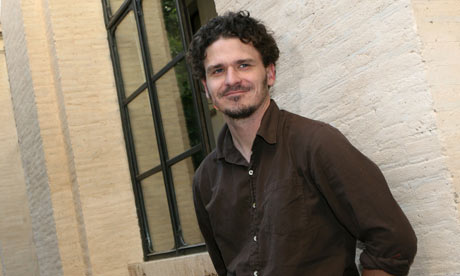
Dave Eggers. (Photograph © Maria Laura Antonelli)

Writer Dave Eggers was recently quoted in a newspaper article : “Writing is a deep-sea dive. You need hours just to get into it: down, down, down. If you’re called back to the surface every couple of minutes by an email, you can’t ever get back down.”

It’s the “…you can’t ever get back down” part that’s been killing me all week. On one of several breaks today to see if I could recover from “Studio Surfacing” as I’ve come to think of it, I chanced upon a slim volume of quotes from literary women.

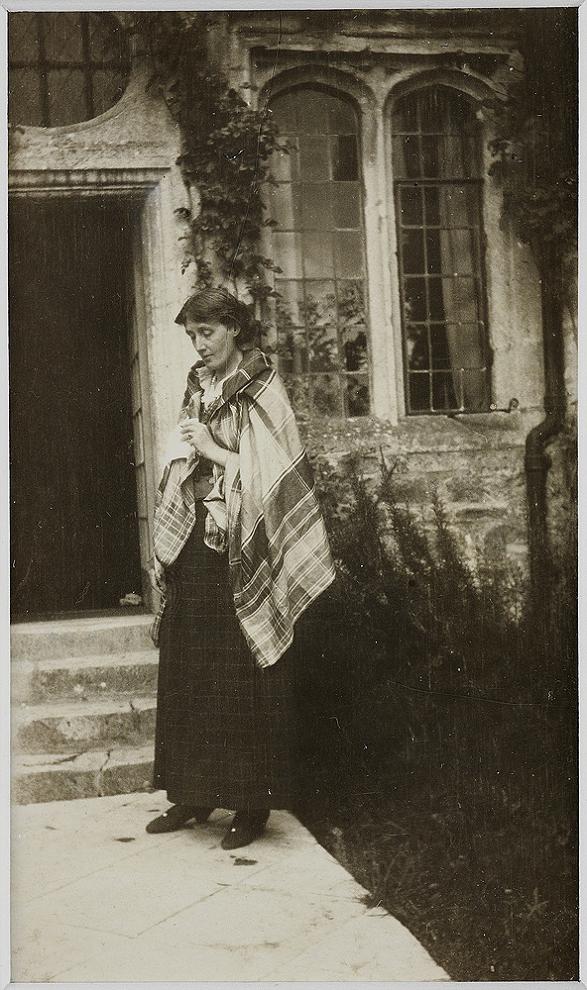
The mighty Virginia Woolf came to my rescue: “Arrange whatever pieces come your way.” Her words stirred my soul.

How fortunate am I that millions of pieces have come my way!

Whether or not I can take a plunge into an Eggers-like-dive after surfacing to answer a phone call or an email, I can arrange my pieces. Every single day I’m aware of one little theatrically intelligent moment or another, from an early decade or a more recent one. So that’s what I did today: began to arrange my pieces.

As I pondered and reflected, more pieces kept coming at me and it was harder and harder to pay attention to the phone. The emails are still waiting.

What a wonderful day.


My Blog-o-logical* Clock: To blog, or not to blog, that is the question…

 
*blog-o-logical: (ADJ) 2009 term coined by Ann Sachs; often paired with ‘clock’ (N). Refers to psychological stress due to time-lapse between Theatrical Intelligence blogposts.

On Mothers Day this year I birthed my blog. My blog-o-logical clock had been ticking for months, and I thought that after publishing the first couple of posts, the tick-tick-tocking would go away. Ha! That is the equivalent of saying that a mother’s work is complete after childbirth.

I have an idea for a book called Theatrical Intelligence. It’s a concept that uses the theatre production model to impact business performance. My blog is also called Theatrical Intelligence; its purpose is to send my ideas about this new concept out into the world to see what comes back to me. It isn’t working.

Aye, there’s the rub.

Nothing is coming back. Why?

FIRST: I don’t blog enough. Responsibilities to my company get top priority. Make no mistake: this is my choice. I co-own the business with my husband and no one is tying me to my desk.

SECOND: I have been uncharacteristically shy about “sending my ideas out into the world.” I’ve hinted. I’ve joined Twitter, and tweeted as @TheatreSmart. I’ve asked my kids what they think. But I haven’t launched, in the sense of sending my own theatrical rocket into space. 

THIRD: Twitter has an irresistible little feature called a Posterous Page. It is, essentially, a mini blog that is as easy to use as picking up the phone. I gave in to this preposterous temptation and have posted 28 little pieces since November, on what I call my (Pre)Posterous Page.

That puts me exactly 3 distractions away from writing the book. Or are they distractions? My partner Roger Morgan believes that so-called-distractions are part of the gestation period of creativity; natural and inevitable, given that the muse does not descend on demand. (I have encouraged Roger to write a book on innovative procrastination techniques. He informs me that the idea is in the gestation phase.)

Writing the book is the goal, I remind myself. Yet my blog-o-logical clock keeps ticking, an incessant reminder that I am committing blog-abuse.  My blog is hungry and wants to be fleshed out, to grow, to become the catalyst for getting the book out in the world.  Every day my inner critic (the 8th role of Theatrical Intelligence, by the way) prevents me from posting deeply shallow articles.

Thus conscience does make cowards of us all.

HOWEVER… cowardice doesn’t seem to fit comfortably. Therefore, I proclaim that in 2010 I will:

FIRST:  L-A-U-N-C-H the blog, such as it is, into the world.

SECOND:  Work on T-H-E  B-O-O-K

‘Tis a consummation devoutly to be wish’d.

Please join me as a conversation partner in this quest, and subscribe to my blog. Pass it along to friends and colleagues. And most important: share your feedback; one of the 6 Principles of Theatrical Intelligence is that “Failure is the quickest way to learn.” If I’m off the mark in your opinion, please let me know. That’s the way this dream will take flight.

Thank you. And may the new decade see your dreams come true.

Rocco at TCG: Back From Peoria

Rocco Landesman

Rocco Landesman

Rocco Landesman had just gotten off the plane from Peoria on Saturday when he arrived at the Theatre Communications Group Fall Forum. We were a group of about 120 TCG theatre members and board chairs, gathered at the Desmond Tutu Center in Chelsea. (Full disclosure: I am neither a theatre member nor a board chair; I had received special permission to attend.*) Everyone in the room was honored that Rocco had carved out the time to meet with us so early in his tenure at NEA, and we were eager to hear what he had to say.

I don’t know Rocco well, although he was our Studio landlord for a few years. As he walked in I didn’t so much assault him as take the opportunity to congratulate him on his provocative entrance into his new role, and to express my hope that he wasn’t discouraged by his critics. His response: “Ann, I’m 62. I’m not about to change now.” I don’t know why I expected anything different, but it was so reassuring to hear those words I almost threw my arms around him and kissed him on the lips. I tend to be a little over-the-top in situations like this, so decided against it.

Rocco opened his talk by telling us about a “gruesome meeting on the Hill” recently, after which he told his wife Debby it reminded him of a favorite old country song: Joe South’s These Are Not My People. Then he told us that he was relieved to be here, because “…you ARE my people!” Vigorous applause. It  felt good to be included.

He drew a parallel between the theatre as “the most aspirational of activities” and the Obama administration as driven by aspiration. In his no-nonsense-get-to-the-bottom-line style, he respectfully referred to our President as an artist “…who has faced the blank page” and succeeded in that perilous journey. And he spoke passionately about the theatre as “…the most essential, the most basic and primal of all human activities; the activity that appeals to our deepest needs and impulses.” It was stirring. “I mean it’s gossip – we’re overhearing people talk when we go to a play!” Impeccable timing.

He went on to explain that if we hadn’t heard about “Art Works” yet, we would soon, with its triplicate meaning :

1. Art works on the wall, as in “a piece of art”.

2. Art works to transform lives, as in his case, he was changed forever when he saw Long Days Journey…

3. Art IS work!  As in: there are 5.7 million arts related jobs in our country.

Rocco spoke from his heart, and didn’t refer much to his scribbled notes on a yellow pad. He admitted that the Chairmanship is still so new to him he hasn’t figured out how it works. He is comfortable in his discomfort, however, and is not afraid to fail. It is one of the reasons I’m so excited about his arrival in Washington; he is living proof of the Theatrical Intelligence principle: failure is the quickest way to learn.

He was a good sport and answered a few questions we had submitted earlier in the day. His lack of endorsement for ‘No Child Left Behind’ was palpable: “It leaves too many children behind who could be saved by arts programs.” He spoke of a charter school in New Orleans which gave him a glimpse into an inspired program, as he watched young children start the day singing Fats Domino songs.

And he answered my question (don’t even ask how thrilled I was) which was “By what measure will you define your success at NEA?” His answer was to tell of the crusty old New Englander who was asked his advice about what makes a happy life. His answer: faster horses, younger women, better whiskey, and more money.

Rocco: I’ll let the first three go, but without a doubt the way I’ll be judged is by how much money I can bring into the NEA. What can I say? I am optimistic. And with apologies to Mel Brooks – perhaps my optimism is delusional –  I can’t help it, I’m a broadway producer.

Applause. Standing ovation. Exit.

My opinion? Perfect casting.

*I was meeting Futurist Jack Uldrich, a Twitter pal, who had presented a stimulating talk on “unlearning” earlier in the day.


A Leap of Faith: Actor. Warrior. Hero.

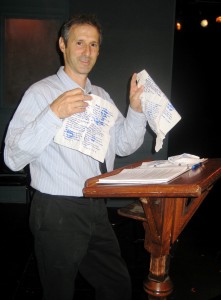
Rich Topol: Actor. Warrior. Hero

Rich Topol: Actor. Warrior. Hero

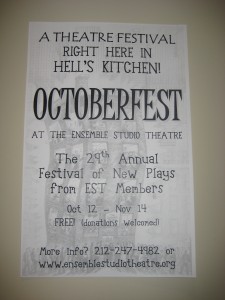
I just completed directing a project in the 29th Annual Octoberfest at the Ensemble Studio Theatre* in New York’s Hell’s Kitchen. I am writing this blogpost because an exceptional actor named Richard Topol has inspired me. Rich, as everyone calls him, is a perfect example that actors are as courageous as any warrior. Truly, they are heroes.

Rich probably has no idea how much his work meant to me in the few days we worked together.  I suspect he believes he was just doing what he does as an actor.

The project was David Perry’s Eulogy, a one-person play in which a man comes to an emotional reckoning with his abusive mother as he eulogizes her. The play could be described as the technical equivalent of singing four arias in forty minutes and performing Hamlet’s soliloquies in between. And this with one rehearsal.

I had seen Rich on Broadway in a hilarious and heart wrenching performance in Awake and Sing, but met him for the first time at our one rehearsal prior to the two readings. Within 5 minutes it was clear that he trusts himself to exist fully in the moment; if he gets lost along the way he has the courage to live in the unknown – essentially in free-fall – until he discovers something he can grab on to and move on. This, of course is one of the principles of Theatrical Intelligence: success comes with having the courage to step into the unknown.

Actors must find a comfort level with whatever they’re doing, and a staged reading of a demanding script in front of a savvy audience with virtually no rehearsal can be daunting. Many actors just won’t do it. Understandable. It is rather like being asked to jump off a cliff not knowing if your parachute is going to open. Other actors, and Rich is one, are willing to take that leap of faith, and jump.

In the talkback after the first of the two readings, when asked about his experience during the “performance”, Rich responded  “It was exhausting! Sometimes I didn’t remember what was coming next on the page, and when I got there it wasn’t what I expected. So I thought, OK, I’ll live here for a while and just see what happens.”

86 Plays. 38 Days.

86 Plays. 38 Days

What if we could all live this way every day? “Live here for a while…” not knowing where it might lead. If we can trust that it is OK not to know where we are emotionally or intellectually or spiritually, it leaves open the possibility of discovery. If we are open to discovery, just think what new things we can learn!

Billy Carden, the Artistic Director of EST, says: “…if you believe in discovery, if you want to be entertained by the unexpected, surprised by the spontaneous, if you want to hear a new voice for the first time, or a familiar voice in a new way, if you want to experience the spirit of work in progress: join us.”

Thank you, Rich, for your leap of faith. You are a hero.


*EST was founded in 1972 to nurture individual theatre artists in the development of new American plays, and has produced 6,000+ new works over the decades.  I have been a lucky member of this family of 500 theatre artists since 1977.

Follow Your Fear

(Or “Is That a Dead Moose on the Table?!”)


Recently a Theatrical Intelligence blog reader posted a question about conflict in the workplace; she wondered if using theatrical intelligence could help resolve the tricky issues of conflict that frequently occur at work. The answer is yes, Yasmin, and thank you for asking.

Many of us have a fear of conflict at work, which is often reminiscent of family quarrels and hierarchy. We tend to go to great lengths to avoid it, because it makes us feel embarrassed, uncomfortable, and often powerless.

It would benefit us to follow one of the guiding principles of improvisation: “follow your fear”.1

When professional actors improvise in performance, they actually look for obstacles to overcome. Obstacles provide dramatic conflict and the opportunity to venture into unexplored territory. “Following one’s fear…” authentically, under imaginary circumstances, is a proven improvisational technique; it produces behavior that can be eccentric, paranoid, emotionally unpredictable and frequently humorous in a surprising kind of way.

There is only one way to really screw up in improvisation: deny reality.  For example, when two actors are on stage and one of them puts her jacket over her head to protect her from… whatever… the reality of the imaginary circumstances has been established. The other actor accepts it as a gift and immediately uses it. Is it raining? Snowing? Are there pigeons above? Is paint dripping? One or the other will establish what the jacket is protecting them from, and that will be the reality they share and build upon.

Acceptance of the reality, as it is being established, is paramount, in order to build a concrete story.

In many workplaces a denial of reality is the norm. We’ve all experienced situations where there is no acknowledgment of what is really happening (hence the expressions: “the elephant in the room” or “the dead moose on the table”).

Denial of reality inevitably breaks down trust and builds up fear. Acceptance of reality opens up worlds of possibility.  What if you were to “follow your fear” in the face of a workplace conflict? What if you were to have the courage to say “The dead moose on the table is beginning to smell – what shall we do about it?”

I suspect that you and your colleagues at work might discover unexpected behavior and opportunity. Accept the response as a gift, just like in improvisation. Follow your fear, and see what happens.

1 This expression was coined by the late great Del Close at Second City, about 50 years ago.

In Memory of my Mom – Origins and Influences

Theatrical Intelligence in Triplicate

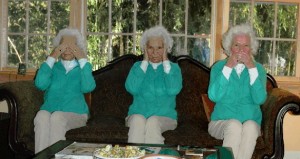
Mom died 2 weeks ago. Jeanne O’Sullivan Sachs: Oct 15, 1920 – July 19, 2009. I was blessed to be with her as she made her final exit, as were my siblings.  In her honor, I post “Three Moms”, taken by my younger brother Bob. It is the quintessential Mom: elegant, poised, and laughing at the delicious irony of life. “See no evil. Hear no evil. Speak no evil.”

I’ll be posting my thoughts about my mother as soon as I have the presence of mind to edit my daily “ritual writings”. She had Theatrical Intelligence in abundance!

In the meantime, I’d like to share the a piece of writing dictated by Mom to me on Thanksgiving Day, 2007. She was 87. Our family was playing a game from Mary Pipher’s Writing to Save the World, called “I am from…” It’s about origins and influences.

So ladies and gentlemen, in her own words, Jeanne O’Sullivan Sachs:

* I am from Mortimer O’Sullivan, Patrick Ahearn, Ellen O’Brien, Agnes Ahearn, and John Mortimer O’Sullivan.

* I am from Irish Catholics and Irish Catholics and Irish Catholics and Irish Catholics!

* I am from Ireland, Ballyporene and green and history and the brogue.

* I am from Billerica and Boston.

* I am from “Children are seen and not heard”; “Jesus, Mary and Joseph!”; “A book is your friend, you must not destroy it” and mass on Sunday morning (as late as possible for Dad!)

* I am from Mildred McKean the music supervisor telling my parents “You have a very gifted child” and arranging a cello for me.

* I am from… (no, that sounds too braggy!)

* I am from my doll Betty, a gift from Grandfather Ahearn – tailor to Harvard Square – making me jodhpurs when I was thirteen.

* I am from cello recitals and music camp as one of the professionals (I don’t know how they found me!)

* I am from summers on the Cape with my brothers and sisters in Wellfleet.

* I am from sitting at the soda counter and ordering an ice cream sundae while Dad always had a coke and said “…add a little lemon.” That was so grown-up!

* I am from Children’s Hospital and Sidney Farber at Harvard and Faure’s cello sonata which was when Ernie fell in love with me.

* I am from daffodils and 4/3/43, our wedding day.

* I am from 54 months of pregnancy, six kids, being a chauffeur, learning to ski, teaching cello, founding an orchestra and getting my masters – it didn’t take very long – they gave me credit for life.

* I am from my six children and my thirteen grandchildren and my great-grandson Jack and more “greats” on the way. (Good “Jeannes and Ernies”.)

* I am from…four score and seven years ago!

R.I.P. Mom.

Your final words were “Love you”. Thank you for everything. Love you too.


Skip to toolbar